Campaign group 38 degrees have produced a map of the NHS crisis in the UK that purports to show the location of signatories to a petition demanding improved resources for the NHS.
Click here to put in your own UK postcode and here if you want to just see the map I've screen grabbed below
.
Each signatory is shown with a lovely blue Google map pin (zoom out to get the full 'death by map pin' effect just for kicks). Here's the cartography bit: "To protect anonymity, we randomly assign locations in the constituency for each signature. No real locations are shown."
Say what?
So you take data, you ignore location other than it exists within a certain boundary, you give it a false location and then put it on a map. Let's just zoom in a bit...
There you go. Mr Gordon Bennett in that lovely house round the corner signed the petition. Except he didn't, did he, because this is a randomly placed marker. Someone in the area whose postcode cannot define a particular property has had their data pinned to Mr Bennett's house. I suspect that pisses them both off.
This sort of map tells this huge lie while at the same time purporting a level of precision that assigns the unreality to very particular houses on the map. It's a verson of the ecological fallacy in the interpretation of statistical data where inferences about the nature of individuals are deduced from inference for the group to which those individuals belong. In this case precise location...albeit randomly assigned.
If you're going to randomize the data for display (a good thing) then aggregate it into a choropleth (you clearly have the boundaries which you're using to demarcate the selection) or show the postcode totals as a proportional symbol or do anything other than use point markers that make no sense and, worse, impute nonsense. Total cartojunk that obfuscates the real message. Put the damn numbers on the map. Make them big. Make those crucial messages the visual.
ht @StevenFeldman
Showing posts with label symbols. Show all posts
Thursday, 2 February 2017
Tuesday, 12 April 2016
Grid-O-gram
I had the pleasure of working with Mamata Akella when I first started at Esri. Mamata went on to work for the National Park Service and is now at CartoDB where she seems able to flex her design wings with thematics. This is fertile space in mapping in general and it seems never a week goes by without someone re-inventing a thematic mapping technique, occasionally with a new twist. Mamata's latest map caught my attention.
In response to her call for comments I hope she won't mind me using this blog as a space in which to offer my opinion and insight so here's a critique of the map above.
It's visually arresting. It's one of those maps you immediately stop and look at so it does a great job of getting people to pause and spend some time with it. That's probably the point so it's already done it's job. Because it lacks a title or any popups or marginalia one quickly gets lost though. As Mamata explains, it's a test and, no doubt, not designed to be used as a fully fleshed out project but it would be useful to include the basics.
It's the 2012 US election data. A well worn dataset that's just about exhausted most techniques. I spent some time with it myself a couple of years ago creating a gallery of various thematic map types. But with the 2016 election on the horizon many will be experimenting with new or modified techniques to prepare for that mapping extravaganza (me too...but you'll have to wait for that).
So what's going on in this map? Mamata calls it a 'modified cartogram'. Symbol size is total vote. Colour is the winner (red=republican, blue=democrat). Units are counties.
First off - I like the appearance and I like that it's in an equal area projection (Albers). It's eye-catching and somewhat different. I then quickly get uncomfortable with the function and how the data processing encodes meaning. Clearly the real geographic boundaries have been processed. My sense is a regular grid of rectangles has been used in which to bin the counties that fall within. That explains the regular grid and also the irregular number of symbols per location.
Geographical boundaries have been replaced by an abstract geography. It's referred to as a cartogram, likely because of this abstraction but a cartogram it is not. Cartograms distort space but they don't aggregate in an irregular fashion. Think Gastner-Newman, Dorling, Demers or a basic non-contiguous cartogram which all treat geography in different ways but which do not apply a binning technique as an interim step. Further, cartograms don't have overlaps. Mamata's symbols do overlap. It's therefore difficult to know how many counties are represented by each location and it's difficult to ascertain the distortion of the underlying geography which will inevitably be greater in areas with larger numbers of smaller counties. It's adding in a visual complexity that isn't necessary even though it gives a neat (as in regular - pleasing to the eye) looking final appearance.
I don't particularly like the way transparent overlaps on the symbols yield overlaps with darker shades - to me that visually implies 'more' yet is purely an artifact of symbol size bleeding into an adjacent symbol and not necessarily a function of geography at that place or overlapping geographies. Of course, when we're talking about mixing blues and reds it gets even more difficult to visually disentangle. That''s not a problem simply on this map though. I wrote about it before in regard to proportional symbol maps.
So it's a gridded proportional symbol map? Looks that way. Are symbols stacked? Possibly - in which case a lot of colour is missing due to occluded symbols which changes the ratio of blue:red colour across the map as a whole. If the data is really represented as rings then OK, we're seeing everything but it's also hard to determine why some symbols have more transparency applied than others (strength of vote?).
There's no labels which makes it difficult to describe the pattern verbally and causes even more problems if you don't actually know this is the USA. When you zoom in, the map refreshes with some very big changes in symbol size and larger white spaces so the structure we see for the whole is lost. This makes it hard to retain a mental image of pattern at one scale and compare it to that at another and we very quickly lose where we are on the map.
If it's a proportional symbol map then why not just use geography, even if you discount the boundaries and make a proportional symbol map?
I'll tell you why - they just ain't sexy enough in today's modern mapping landscape. So that's why Mamata experiments. It's why I experiment too. Sometimes we hit, sometimes we miss in our search for something just a little bit unique to develop cartography and showcase the tools and technology of our trade.
For my money this is a miss. I like the look but I think it complicates the subject matter and confuses the cognitive process of understanding the patterns in the data. For me, form should never outperform function. Cartography really is, at its very essence, that art and science of marrying form and function in harmony. You've got to get both right to make a good map.
Back to it being a cartogram - no. It isn't. But maybe Mamata's created a grid-O-gram?
Update: Inevitably, whenever I do one of these critiques I get called out for it being on a map made by someone who works somewhere that I don't. First, Mamata asked for comments. Second, I couldn't care less where she works and this IS NOT about the tech she used. None of my critiques are about the tech. It's about the cartography. Sure, tech affords opportunities or constraints but I don't care one bit about who uses what. This is not about scoring points. I don't publicly critique maps made by colleagues at the place I work because there are better mechanisms for me to use to try and effect change from within. And surely, if anyone thinks it's a good idea openly calling out your employer and those who you work with, you must work in an incredibly forgiving place. I do call co-workers maps out all the time using appropriate avenues. They critique mine too...often in very stark terms. Critique is good. Using different mechanisms to get the job done is important for cartography whomever you work for. So - don't get irate just because Mamata and I work at different companies. It's irrelevant. And yes, many maps I see made by friends, colleagues or whomever are truly awful and I tell them that. Silence in a public space can often be deafening.
In response to her call for comments I hope she won't mind me using this blog as a space in which to offer my opinion and insight so here's a critique of the map above.
It's visually arresting. It's one of those maps you immediately stop and look at so it does a great job of getting people to pause and spend some time with it. That's probably the point so it's already done it's job. Because it lacks a title or any popups or marginalia one quickly gets lost though. As Mamata explains, it's a test and, no doubt, not designed to be used as a fully fleshed out project but it would be useful to include the basics.
It's the 2012 US election data. A well worn dataset that's just about exhausted most techniques. I spent some time with it myself a couple of years ago creating a gallery of various thematic map types. But with the 2016 election on the horizon many will be experimenting with new or modified techniques to prepare for that mapping extravaganza (me too...but you'll have to wait for that).
So what's going on in this map? Mamata calls it a 'modified cartogram'. Symbol size is total vote. Colour is the winner (red=republican, blue=democrat). Units are counties.
First off - I like the appearance and I like that it's in an equal area projection (Albers). It's eye-catching and somewhat different. I then quickly get uncomfortable with the function and how the data processing encodes meaning. Clearly the real geographic boundaries have been processed. My sense is a regular grid of rectangles has been used in which to bin the counties that fall within. That explains the regular grid and also the irregular number of symbols per location.
Geographical boundaries have been replaced by an abstract geography. It's referred to as a cartogram, likely because of this abstraction but a cartogram it is not. Cartograms distort space but they don't aggregate in an irregular fashion. Think Gastner-Newman, Dorling, Demers or a basic non-contiguous cartogram which all treat geography in different ways but which do not apply a binning technique as an interim step. Further, cartograms don't have overlaps. Mamata's symbols do overlap. It's therefore difficult to know how many counties are represented by each location and it's difficult to ascertain the distortion of the underlying geography which will inevitably be greater in areas with larger numbers of smaller counties. It's adding in a visual complexity that isn't necessary even though it gives a neat (as in regular - pleasing to the eye) looking final appearance.
I don't particularly like the way transparent overlaps on the symbols yield overlaps with darker shades - to me that visually implies 'more' yet is purely an artifact of symbol size bleeding into an adjacent symbol and not necessarily a function of geography at that place or overlapping geographies. Of course, when we're talking about mixing blues and reds it gets even more difficult to visually disentangle. That''s not a problem simply on this map though. I wrote about it before in regard to proportional symbol maps.
So it's a gridded proportional symbol map? Looks that way. Are symbols stacked? Possibly - in which case a lot of colour is missing due to occluded symbols which changes the ratio of blue:red colour across the map as a whole. If the data is really represented as rings then OK, we're seeing everything but it's also hard to determine why some symbols have more transparency applied than others (strength of vote?).
There's no labels which makes it difficult to describe the pattern verbally and causes even more problems if you don't actually know this is the USA. When you zoom in, the map refreshes with some very big changes in symbol size and larger white spaces so the structure we see for the whole is lost. This makes it hard to retain a mental image of pattern at one scale and compare it to that at another and we very quickly lose where we are on the map.
If it's a proportional symbol map then why not just use geography, even if you discount the boundaries and make a proportional symbol map?
I'll tell you why - they just ain't sexy enough in today's modern mapping landscape. So that's why Mamata experiments. It's why I experiment too. Sometimes we hit, sometimes we miss in our search for something just a little bit unique to develop cartography and showcase the tools and technology of our trade.
For my money this is a miss. I like the look but I think it complicates the subject matter and confuses the cognitive process of understanding the patterns in the data. For me, form should never outperform function. Cartography really is, at its very essence, that art and science of marrying form and function in harmony. You've got to get both right to make a good map.
Back to it being a cartogram - no. It isn't. But maybe Mamata's created a grid-O-gram?
Update: Inevitably, whenever I do one of these critiques I get called out for it being on a map made by someone who works somewhere that I don't. First, Mamata asked for comments. Second, I couldn't care less where she works and this IS NOT about the tech she used. None of my critiques are about the tech. It's about the cartography. Sure, tech affords opportunities or constraints but I don't care one bit about who uses what. This is not about scoring points. I don't publicly critique maps made by colleagues at the place I work because there are better mechanisms for me to use to try and effect change from within. And surely, if anyone thinks it's a good idea openly calling out your employer and those who you work with, you must work in an incredibly forgiving place. I do call co-workers maps out all the time using appropriate avenues. They critique mine too...often in very stark terms. Critique is good. Using different mechanisms to get the job done is important for cartography whomever you work for. So - don't get irate just because Mamata and I work at different companies. It's irrelevant. And yes, many maps I see made by friends, colleagues or whomever are truly awful and I tell them that. Silence in a public space can often be deafening.
Saturday, 6 June 2015
Colour me bad
Cartographers have often been accused of doing little more than drawing lines and colouring in. It's a rather negative and stereotyped perception that fails to acknowledge the many different aspects of the job of making a map or indeed, to what purpose the map design is intended to support.
I've therefore become concerned at the growing trend of maps that appear to be created simply to showcase, how do I put it, drawing lines and colouring in. Most of us probably had paint-by-numbers kits as kids but we grew up and started with a blank canvas which was far more challenging but ultimately, more rewarding. Cartography has regressed to paint-by-numbers. People no longer start with an empty canvas. Having the data and colouring in tools is so useful in so many ways but for far too many it's just an excuse to do some mapping by numbers. We're not being stretched to think about the map any more. We're simply putting together component pieces from others and painting them in different ways.
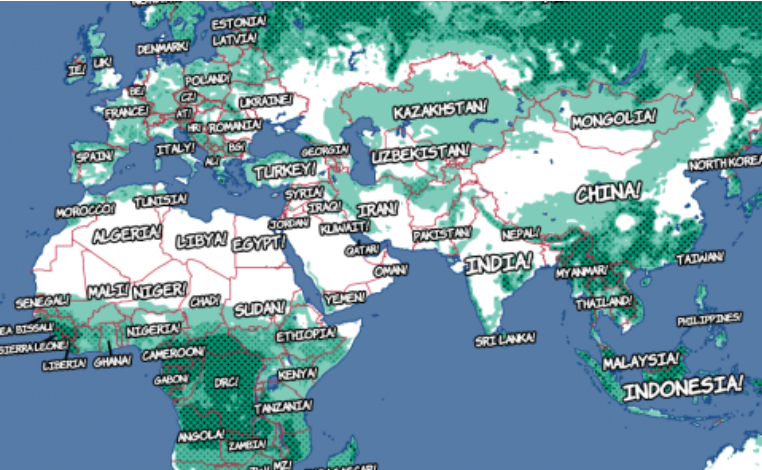
Take the following examples which have garnered much love on the interwebs. I'm deliberately not naming the authors and I have no particular issue with the end products because on the whole, aesthetically, they work as pieces of art. But do they work as maps? I think they're illustrative of a paint-by-numbers craze in modern cartography.
One of the major requirements for a map has always been base data to give context, situate our own data or simply to indicate the pattern that humans make on the natural landscape. Over the past few years acquiring base topographic data has become ridiculously easy through the many open and paid-for suppliers that exist. Many of these come pre-styled into designs that support a variety of uses. Many of them can be re-styled using a number of different approaches. The processes of data collection, processing and generalisation are largely ignored by today's modern map-maker. Instead, they simply regurgitate other people's data and re-style to distinguish their map from everyone else's maps. The maps above then leave it at that. They go no further and they offer no clue as to what their eventual purpose might be other than as an example of painting data.
The result of all of this artistic expression is simply that we're seeing an awful lot of re-styled versions of the same data. They are painted maps in their own right but what function do they support beyond that? They appear to exclaim that form is the end-goal and function is all but forgotten. Pretty yes, but none of the maps you see above can really be used for anything purposeful. The balance between figure and ground is so often forgotten in many of these re-styled maps as well..and the typography is often poorly integrated. Putting our own data on top of them would be pure folly.
The maps are fun it’s true. But is the exercise of colouring in data doing
anything to enrich cartography? In its simplest
form we're using freely available vector data, popular and widely available
design and production environments and then, well, changing the colours of the
vectors. What does this prove? It proves we're able to find the RGB values
of some inspirational art or colour schemes from nature and then change the map data accordingly. This is
nothing more than buttonology – a longstanding issue, debate and criticism of
digital cartography and geo-technology in general. We're losing our ability to understand the structure of the data in a cartographic sense or to wrestle with it in conjunction with typographic elements, layout or thematic overlays. We're losing our understanding of cartography.
Of course, we've been conditioned to accept that a pre-styled base map is adequate for making maps. How many maps do you see where someone puts a choropleth on top of a topographic basemap for instance? Using topographic, or reference, base maps just makes no sense for thematic cartography but it's an easy solution because it requires no effort. Actually, getting the balance between base and theme, ground and figure does require effort and should be part of our concern as cartographers. Effort is required. Effort should be rewarded but I see far too many of these painted maps get accolades they scarcely deserve.
Painted maps tend to show little cartographic quality. The re-painting of the data only illustrates the map-maker's ability to use a piece of software. There's no real generalisation
of the data; selection of data or omission of clutter. There's hardly any graphical hierarchy built in to the map or emphasis on how colours interplay between symbols or across the map. Random features get symbolised in bizarre ways simply because the data exists so it should be coloured. How could the lines be simplified or exaggerated to
the extreme but still give us a sense of the map? How might clarity or
legibility be changed and to what extent? Is it possible to invert the data in
a visual sense or play with the layout in ways the riff off approaches in art more generally? And what happens when you zoom in or out of the map...does the style update as the data is progressively generalized or modified at different scales? Rarely does any of this happen. We simple get more of it at larger scales but there's little nuance to the way the data is portrayed.
A lot of art deconstructs images and objects. Think of
how Warhol approached bananas or a tin of Campbell’s soup or a picture of
Marilyn Monroe. His art was to express the figure of his work in a new,
different way. Re-colouring data on a map doesn't go far enough. It doesn't show any sense of design acumen. Maybe I'm just getting bored of all the so-called re-imaginations of map data but where is the originality? Where is the expression? Where is the cartography?
It's always nice to play around with maps and experiment (I do it all the time) but at some point we've got to go beyond being seduced by the technology and get back to understanding of the map and the relationship between aesthetics, form and function. Learning to change the appearance of symbols is good. Goofy and experimental mapping is also good. 'Goofy and thinky' is, to quote Hannah Fairfield (of the New York Times at OpenVis 2015), far better.
It’s the thinky bit that I feel is missing from this type of
work and that the seduction of being able to use the data and do something to
it relatively easily is what counts for many. Over the last ten years or so,
the shift in time from having to collect and process all this data before you
can even get to styling it has been profound. Someone’s done all the hard work.
Actually, millions of people have done the hard work. Isn’t it incumbent on us
to honour this work and take it further than simply painting it?
I think this sort of work might be generally called
inconsequential cartography. I’d like to see more consequential cartography.
I’m all for playing with the map in artistic ways but take it further. Make a
statement. Make it say something. Make it work in concert with some other data
to create a map, rather than just changing the basemap. Give it a real purpose.
Give it a context. Marry the playful form with a function.
Wednesday, 1 October 2014
The cartography of Luminocity 3D
I've just had a good look at Luminocity 3D by Duncan Smith of CASA, Bartlett UCL. I'm impressed.
Web mapping is beginning to show signs of getting beyond the infantile and maturing from its pubescent phase and this example shows what can be achieved when you consider the entire user experience.
The maps are clean and well produced and there are plenty of them to support the inquiring mind, each accessible from a sensible tabbed box in the upper right. There's a permanent legend in the bottom right with not only a clear illustration of the chosen classification and shading schemes but a short description to assist interpretation. Nice to see data attribution and sources cited too. The title panel is sensible and although containing all the usual share and contact buttons is relatively unobtrusive. The graph in the bottom left is a masterstroke - it's linked to the map so we get a good scattergraph overview of the data distribution. Hovers provide the data summary and clicking a component in the graph orients the map appropriately. I really like the use of subtle graphical cues such as a slight animation to show an active element, or the emerging horizontal or vertical lines to anchor your eyes to the x or y axis. Likewise, hover controls on the map also deliver data summaries and the addition of a graphical yellow glow also gives focus. The ability to switch labels on and off easily also gives both unencumbered and contextual view of the map.
I also like the use of data re-apportionment into a consistent regularly tesselated grid which overcomes the problems of trying to use different geographies. It also makes moving between maps easier and supports visual comparisons more readily.
All that said, I'm going to get picky (because that's the purpose of the blog). I found myself frustrated by some of the cartographic choices.
Firstly, while diverging colour schemes tend to make a map look more interesting (more colours) it doesn't fit the data in a cognitive sense. Most of the datasets would benefit from a single hue progression or similar. Most of the variables are mapped with some arbitrary break defined where one colour morphs into another yet the importance of that critical middle value is never established. Is it important? The use of a diverging colour scheme suggests so but it is unlikely.
In fact, perusing through the maps shows an inconsistency in the graphical treatment. Most are diverging, some are single hue, others are multi-spectral (agh!).
Second, while the use of a regular grid is great the use of 3D on most of the maps is distracting. It's effectively a plan oblique representation of the hexagonal grid using a second variable to map population or employment density. Fine in principle and allows the map to remain planimetric (thus preserving scale across the map) but where you see large numbers of tall prisms it inevitably obscures a lot of detail behind. Prism maps have always suffered this limitation and I can understand that mapping the second variable gives us an important additional piece of information but it's questionable whether the cost of occlusion warrants it. The answer would be to include an ability to view the map from multiple orientations either through a rotate tool or just giving us, say, four of the cardinal compass directions. At least that way the map reader can see what's behind a block of prisms through map interaction.
Finally, the map works on multiple devices and some of the overlying boxes can be minimized - but not all. This does create a cramped feel on some devices and it would be nice for there to be more control over the position and visibility of these.
Like I said, I'm being picky but I'd like to see the cartography match the levels of the overall app, particularly in the use of colour.
Web mapping is beginning to show signs of getting beyond the infantile and maturing from its pubescent phase and this example shows what can be achieved when you consider the entire user experience.
The maps are clean and well produced and there are plenty of them to support the inquiring mind, each accessible from a sensible tabbed box in the upper right. There's a permanent legend in the bottom right with not only a clear illustration of the chosen classification and shading schemes but a short description to assist interpretation. Nice to see data attribution and sources cited too. The title panel is sensible and although containing all the usual share and contact buttons is relatively unobtrusive. The graph in the bottom left is a masterstroke - it's linked to the map so we get a good scattergraph overview of the data distribution. Hovers provide the data summary and clicking a component in the graph orients the map appropriately. I really like the use of subtle graphical cues such as a slight animation to show an active element, or the emerging horizontal or vertical lines to anchor your eyes to the x or y axis. Likewise, hover controls on the map also deliver data summaries and the addition of a graphical yellow glow also gives focus. The ability to switch labels on and off easily also gives both unencumbered and contextual view of the map.
I also like the use of data re-apportionment into a consistent regularly tesselated grid which overcomes the problems of trying to use different geographies. It also makes moving between maps easier and supports visual comparisons more readily.
All that said, I'm going to get picky (because that's the purpose of the blog). I found myself frustrated by some of the cartographic choices.
Firstly, while diverging colour schemes tend to make a map look more interesting (more colours) it doesn't fit the data in a cognitive sense. Most of the datasets would benefit from a single hue progression or similar. Most of the variables are mapped with some arbitrary break defined where one colour morphs into another yet the importance of that critical middle value is never established. Is it important? The use of a diverging colour scheme suggests so but it is unlikely.
In fact, perusing through the maps shows an inconsistency in the graphical treatment. Most are diverging, some are single hue, others are multi-spectral (agh!).
Second, while the use of a regular grid is great the use of 3D on most of the maps is distracting. It's effectively a plan oblique representation of the hexagonal grid using a second variable to map population or employment density. Fine in principle and allows the map to remain planimetric (thus preserving scale across the map) but where you see large numbers of tall prisms it inevitably obscures a lot of detail behind. Prism maps have always suffered this limitation and I can understand that mapping the second variable gives us an important additional piece of information but it's questionable whether the cost of occlusion warrants it. The answer would be to include an ability to view the map from multiple orientations either through a rotate tool or just giving us, say, four of the cardinal compass directions. At least that way the map reader can see what's behind a block of prisms through map interaction.
Finally, the map works on multiple devices and some of the overlying boxes can be minimized - but not all. This does create a cramped feel on some devices and it would be nice for there to be more control over the position and visibility of these.
Like I said, I'm being picky but I'd like to see the cartography match the levels of the overall app, particularly in the use of colour.
Labels:
cartography,
design,
hexagons,
symbols,
webmap
Tuesday, 30 September 2014
On emoji cartography
Thinking of putting emoji on a map? Please don't
Whatever you call them: pictograms, pictorial markers and mimetic markers have always been hugely important in cartography. Well designed graphics that are used to represent a point of interest are fundamental to topographic mapping in particular but have become vital for web maps that show points of interest across a basemap. They should be clear, unambiguous and allow us to efficiently communicate the feature with simple graphic clarity. They should work in harmony with the rest of the map and subtlety often leads to a well balanced overall map.
They're not easy to design though. You're often working with a very restricted size, perhaps pixel count and, ordinarily, a single colour. With all those constraints it's often difficult to imbue symbols with the meaning required if the intent is to support a map reader's ability to understand the feature without constant recourse to the map legend. This reason alone is why it's more common to use pre-defined symbols delivered as part of your software or available online. There are perfectly good repositories for symbols (e.g. Symbol Store, Maki) but what about emoji?
Emoji - the Japanese pictographs which have become standard in electronic messaging. They're increasingly used as shorthand for all sorts of communication.
Their increased use doesn't, however, mean they are well suited to being placed on a map. Take a look at this map, made by Katy DeCorah (click to view the live map as part of Katy's blog).
Katy's blog entry explains she was interested in exploring a technical challenge, and she succeeded. But what of the outcome? Once the technical challenge had been achieved we still need to consider whether it's useful in a cartographic sense and in this case I'd suggest it isn't though Katy did at least use a limited set of POIs and did a good job of picking an emoji that vaguely represents the feature being mapped.
In general terms these sort of symbols create disharmony. The emoji are too detailed, too colourful and too 'cartoony'. They inevitably clash with the background map and where they begin to coalesce (as they will in a multi-scale environment) they become impossible to decipher. Their style doesn't suit most cartographic work unless you have a very specific mapping project...perhaps a large scale children's atlas. They simply don't look good on a map. For balance...there are other cartoony symbols that I'd also vehemently discourage in cartographic terms. Such as:
One of the tenets of the cartographic design philosophy that I was taught was to keep things simple. The KISS principle (Keep It Simple Stupid) holds true for 99% of cartographic tasks. The best advice any budding cartographer can heed is to learn how to be comfortable omitting detail in terms of the overall map and also the individual elements. Creating clean, simple lines leads to a much more harmonious map and one that is, crucially, much easier to disantangle and read. Symbol design goes a long way to creating that harmony. Just because a set of symbols is technically capable of being put on a map doesn't mean they should be.
Slopping emoji (or other 3D style, multi-coloured, shaded pictorial symbols) all over your map just doesn't work. Use them in your social messaging where a single emoji is often added as an exclamation or to characterise an emotion. Please don't use them en masse on a map...it hurts the eyes and as Kirsten Dunst might say, it's just a piece of poo (ht Craig Williams).
Whatever you call them: pictograms, pictorial markers and mimetic markers have always been hugely important in cartography. Well designed graphics that are used to represent a point of interest are fundamental to topographic mapping in particular but have become vital for web maps that show points of interest across a basemap. They should be clear, unambiguous and allow us to efficiently communicate the feature with simple graphic clarity. They should work in harmony with the rest of the map and subtlety often leads to a well balanced overall map.
They're not easy to design though. You're often working with a very restricted size, perhaps pixel count and, ordinarily, a single colour. With all those constraints it's often difficult to imbue symbols with the meaning required if the intent is to support a map reader's ability to understand the feature without constant recourse to the map legend. This reason alone is why it's more common to use pre-defined symbols delivered as part of your software or available online. There are perfectly good repositories for symbols (e.g. Symbol Store, Maki) but what about emoji?
Emoji - the Japanese pictographs which have become standard in electronic messaging. They're increasingly used as shorthand for all sorts of communication.
Their increased use doesn't, however, mean they are well suited to being placed on a map. Take a look at this map, made by Katy DeCorah (click to view the live map as part of Katy's blog).
Katy's blog entry explains she was interested in exploring a technical challenge, and she succeeded. But what of the outcome? Once the technical challenge had been achieved we still need to consider whether it's useful in a cartographic sense and in this case I'd suggest it isn't though Katy did at least use a limited set of POIs and did a good job of picking an emoji that vaguely represents the feature being mapped.
In general terms these sort of symbols create disharmony. The emoji are too detailed, too colourful and too 'cartoony'. They inevitably clash with the background map and where they begin to coalesce (as they will in a multi-scale environment) they become impossible to decipher. Their style doesn't suit most cartographic work unless you have a very specific mapping project...perhaps a large scale children's atlas. They simply don't look good on a map. For balance...there are other cartoony symbols that I'd also vehemently discourage in cartographic terms. Such as:
One of the tenets of the cartographic design philosophy that I was taught was to keep things simple. The KISS principle (Keep It Simple Stupid) holds true for 99% of cartographic tasks. The best advice any budding cartographer can heed is to learn how to be comfortable omitting detail in terms of the overall map and also the individual elements. Creating clean, simple lines leads to a much more harmonious map and one that is, crucially, much easier to disantangle and read. Symbol design goes a long way to creating that harmony. Just because a set of symbols is technically capable of being put on a map doesn't mean they should be.
Slopping emoji (or other 3D style, multi-coloured, shaded pictorial symbols) all over your map just doesn't work. Use them in your social messaging where a single emoji is often added as an exclamation or to characterise an emotion. Please don't use them en masse on a map...it hurts the eyes and as Kirsten Dunst might say, it's just a piece of poo (ht Craig Williams).
Subscribe to:
Posts (Atom)