Showing posts with label map gallery. Show all posts

Wednesday, 7 March 2018

Dotty election map

Well that escalated quickly...

While I've been working on the forthcoming book and mooc I've been doing some data wrangling in the background at work. For the 2012 Presidential election I made a gallery of maps that illustrated diverse styles of cartography along with some comments on the map types. Each map can tell a different story of the election. I've been in the process of updating this with a new gallery of the 2016 election results (currently around ten maps but more to come) and I got to the tricky one - the dasymetric dot density map. It requires quite a bit of manipulation of data so here is the map, and in this blog I'll explain a little of the process.


--------------------------
Update: There's now a web map which shows the data at 6 scales in much more detail than the screengrab above. Check it out here or below:


---------------------------

In 2012 I made a similar map for the Obama/Romney election. It was a product of the web mapping technology of the time. Made using ArcMap (full disclosure for those who don't know I work for Esri - who make ArcGIS). At the smallest scale 1 dot = 1,000 votes. At the largest, 1 dot = 10 votes and if you printed the map out it would be as large as a football field. It took 3 months to cajole the largest scale map onto the web!!! I wanted to update the map and the four years that have intervened have brought new software capabilities. For 2012 I had to generate up to 12 million points and position them. Now, using ArcGIS Pro I can use the dot density renderer and let the software take the strain and if I were going all out then why not try and make a map where 1 dot = 1 vote. So, for me, the map is a technical challenge. Part of what I do at work to push the software to see what it is capable of, to test it and to show others what capabilities it affords.

So how to make the map? Well, it's a product of a number of decisions, each one of which propagates into the map. I'll be doing a proper write-up on the ArcGIS blog in due course but, in summary, a dasymetric map takes data held at one spatial unit (in this case counties) and reapportions it to different (usually smaller) areas. It uses a technique developed by the late Waldo Tobler called pycnophylactic reallocation modellingThose different areas are, broadly, urban. The point of the map is to show where people live and vote rather than simply painting an entire county with a colour which creates a map that often misleads [Waldo sadly passed away recently and I was running the model when I heard of his death a couple of weeks ago. I met him a few times and his legacy to computational geography and cartography is immense].

I used the National Land Cover Database to extract urban areas. It's a raster dataset at 30m resolution. I used the impervious surface categories and created a polygon dataset with three classes, broadly dense urban, urban, and rural. I then did some data wrangling in ArcGIS Pro (more of that in a different blog) to reapportion the Democrat and Republican total votes at county level into the new polygons. There's some weighting involved so the dense urban polygons get (in total) 50% of the data. The urban get 35% of the data and the rural polygons get 15% of the data. Then I got the dot density renderer in ArcGIS Pro to draw the dots, one for each vote resulting in a map with nearly 130 million dots.

The result is a map that pushes the data into areas where people actually live. It leaves areas where no-one lives devoid of data. It reveals the structure of the US population surface. Most maps that take a dasymetric approach will all end up like this but I think there's value in the approach. To me it presents a better visual comparison of the amount of red and blue that the standard county level map that maps geography, not people, and overemphasises relatively sparsely populated large geographical areas.

So the map I saw on my desktop late Tuesday afternoon took 35 minutes to draw. Technical challenge achieved. ArcGIS Pro nailed it. This is a map that I couldn't have made in the previous election cycle. I was excited and so I took a quick screengrab, sent out a tweet and went home to walk Wisley the dog.

And that, I thought, was that. I'd put the map on the backburner and return to doing layout reviews for the book and doing last-minute work on the mooc over the next couple of weeks. But then something unexpected happened. My phone started pinging. Slowly at first but then a little more during the evening as people began to see the map on Twitter and like or re-tweet it. That's nice, I thought. I went to bed. Wednesday morning I woke to a relative avalanche of likes and retweets. I spent the day in Palm Springs at our Developer Summit and my phone never stopped. By the end of the day it had received around 3,000 likes and had been retweeted 2,000 times. I'm writing this Thursday morning and it's currently at 7,000 likes and a little over 3,000 retweets. The side-effect of this 15 minutes of map fame is I've picked up an extra 1,000 followers (25% increase) on my nearly 10 year old Twitter habit.

But there's a problem. The screengrab was quick and dirty and while there have been many and varied comments on the 'map' it's by no means the finished article. I want to create a hi-res version and also make a web map like the 2012 version. I don't have time to do this in the next couple of weeks but it will happen. But be assured, I am aware of a number of issues. Some have already spotted them and commented.

The symbols - I chose a very default red and blue. Each dot has 90% transparency so overlapping dots at this scale will undoubtedly coalesce into clumps. The impression will appear to bleed across the map. I need to tweak the colours (less saturated) and adjust the transparency to get a better effect. I will also likely do what I did for the 2012 map and classify the data so that at small scales 1 dot = 100 or 1,000 etc. To remove visual 'noise' at those scales. I'll also check for too many overlaps and overprinting. I actually think there's a problem in some areas with blue dots overprinting red. There should be more mixing and more purple. And no, there's no yellow dots. The map only displays Democrat and Republican votes in what remains, effectively, a binary voting outcome.

The data - it's county data, reapportioned. Dot maps convey a positioning that is a function of the processing, not where people actually live or vote. Dots are positioned randomly. Some have, quite reasonably, interpreted the map as showing where votes are and this is a fundamental drawback of the approach. No personal information is in the map at all. I also need to double-check a few areas where people have pointed out apparent anomalies in the map, compared to their personal knowledge of the areas. There may be errors. I need to check. That said, it's a function of the way I've used the NLCD so that data is the basis for reapportionment.

The geography - yes, I hold my hand up. There's no Alaska or Hawaii. I apologise. I'm not sure I'll go back as it requires doing some movement of those states to position them around the lower 48 and put them back in. It's easy but a non-trivial task when you're working in a GIS but I'll think about it. I understand this is unpalatable for some and I accept that criticism.

The interpretations - many have offered some fascinating insights into the gaps and the patterns through Twitter replies. I'll be going through these more carefully when the hullabaloo dies down and teasing out some. But more than anything I've been blown away by the nice things that have been said about the map. It shows the election result in a different way. It tells a different story. One of my favourite responses was this by Thomas de Beus...a lovely mashup and play on the classic photo of Trump's preferred view of the data to hang on the wall of the White House by Trey Yingst.


And this is the point of making a map like this. It presents the SAME data in a different way. It leads to different insights, different interpretations and a different perception. Neither of the above are right or wrong. They are different. Of course, we all have out own view on which serves our needs and which we prefer but that's for us as individuals.

My only regret is that I excitedly tweeted a rough version. I should have waited until I made the map properly. I'll do that but I suspect this is my one viral 15 minutes of fame and I regret it doesn't reflect the quality I know the final version will exhibit. A finished map likely won't get the same traction but we'll see. At the very least it has ignited a discussion. It brings different cartographic eyes to the dataset. Will it ever be hung in the White House? Unlikely.

Thanks for your interest and comments thus far!
Ken

Hurriedly written from a hotel in Palm Springs during which time the map's had many more likes, 11 more mentions and I've picked up another 86 followers. I can only apologise to them when they realise I tweet just as much about beer and football as I do about maps.


Sunday, 31 December 2017

Favourite maps from 2017

I've been a little busy writing my book this year so blog posts have been a bit thin on the ground. It was only as I was packing up for a short Christmas vacation that I realised I hadn't even compiled my list of favourite maps from the year. So, with some of the world already embarking on 2018 here's a selection of maps that piqued my interest in 2017...in no particular order.

Trump's World by Phoebe McLean (age 15)
There probably isn't a better summary of the world in 2017 than this lovely hand-drawn map which won an ICA Children's map competition award


Planet Brewdog by Craig Fisher
It's just a map of Brewdog locations but it's massive and a perfect way to fill up an otherwise plain wall in a modern industrial brewery facility. Here, in the Columbus OH tap room.


Winter Map of Montana by Kevin Nelstead
I particularly like the halos on the white labels :-)


Tactile Atlas of Switzerland by Anna Vetter
Beautifully produced atlas for the blind and partially sighted using raised printing.


Cinemaps by Andrew Degraff
Stunning axonometric maps of over 30 films charting major plot lines and characters as they move through the film's landscape.


The new Swiss World Atlas by the Institute of Cartography and GeoInformation at ETH Zurich
A stunningly beautiful, rich and detailed atlas for secondary school children...actually, for anyone!


Blue and White Dream by anon (China)
Making a map with only a single hue is hard. This is visually stunning, especially set within a large Chinese wall hanging. Apologies, I don't know who created it.


Where the Animals Go by James Cheshire and Oliver Uberti
OK, so the UK version was published in 2016 but the American version was definitely published in 2017 and therefore qualifies. After the success of London: The Information Capital, James and Oliver hit gold again with this award-winning atlas of over 50 great maps plotting animal movement.


San Diego Emoji map by Warren Vick and Europa Technologies
Using gridded emoji is a great idea for a one-off map.


Fifty years of cyclone paths inside the Philippines by David Garcia
Just the lines drawn by the data but revealing the shape of the islands and, with it, the scale of the phenomena.


World Happiness by National Geographic Magazine
I'm a sucker for a multivariate Dorling cartogram Chernoff Face combo.


Lights On and Lights Out by John Nelson
Simple idea mapping the difference between NASA's 2012 and 2017 Earth at Night imagery. Exquisitely rendered.

The best places to see the eclipse by Josh Stevens and NASA
The use of clouds to show, err, the likelihood of cloudcover (and the inverse, clear skies) for the 2017 Solar Eclipse. Simple. Effective.


The Melting of Antarctica by Lauren Tierney
Stunning spread in National Geographic. Great composition and use of angle and projection to tell this story.


U.S. Airport ID requirements by The Washington Post
Neat, interactive use of the gridded cartogram


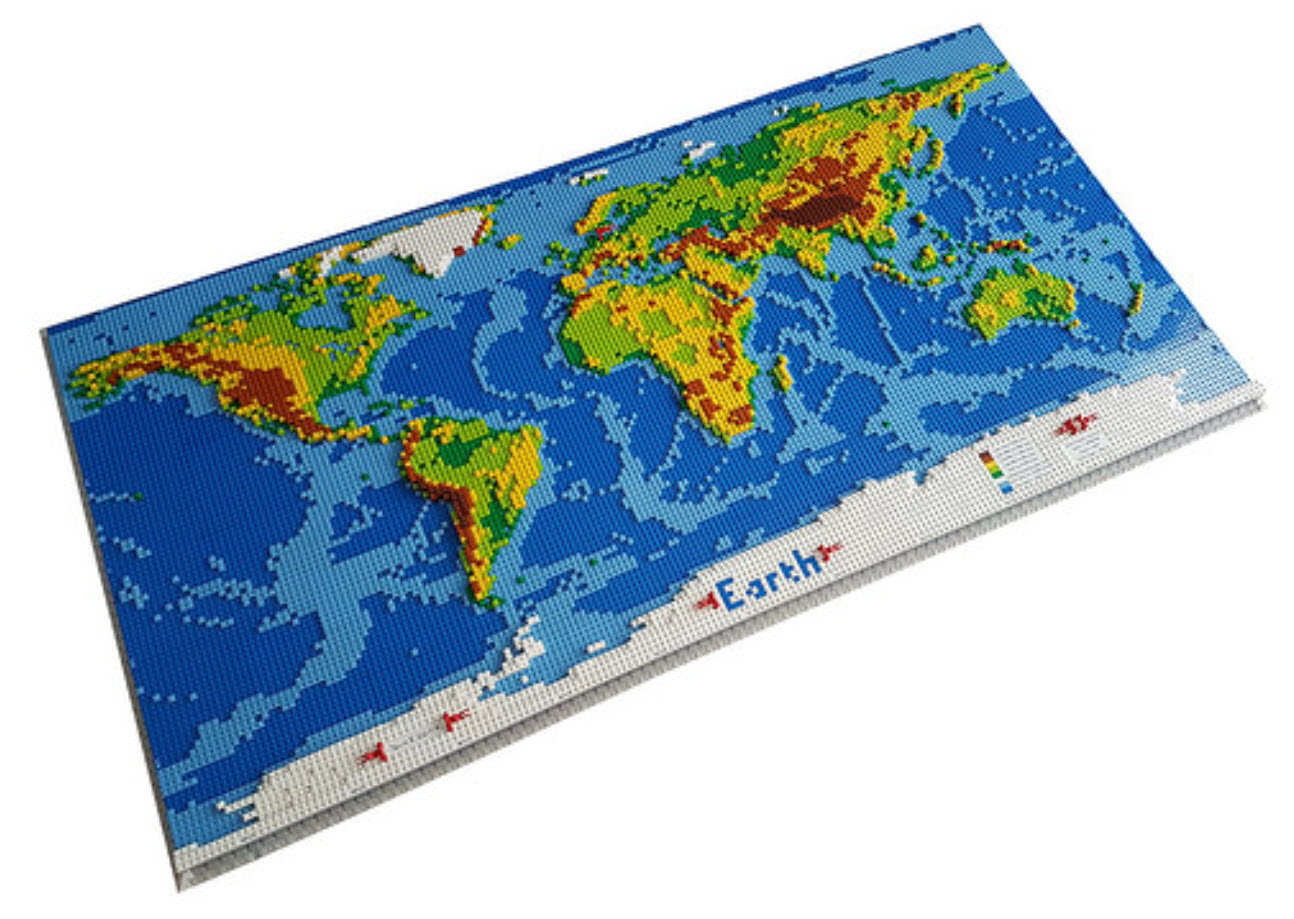
Dirk's Lego World map by Dirk
Because...maps AND Lego!!!

 
Hand-stitched London Underground by Tasha Wade
Gifted to me. Unique. One-of-a-kind. Thank you :-)


Trump's Ties by Kenneth Field
It's my list so here's my effort...I still quite like it. Won the Society of Cartographers Wallis Award too :-)


Tuesday, 22 December 2015

Favourite maps from 2015

I feel it's been a good year in cartography. Since I started this blog, focusing on cartographic howlers, the various tools with which people make maps have improved and the quality of maps is also improving. Maybe there's some learning going on? Maybe people are striving for a better product? Maybe it's just harder to make mistakes? Whatever the mix of forces at work, I've woken more often to a decent diet of maps across social media than in previous years which can only be a good thing.

Of course there's still real humdingers and cartofails but there always will be. The balance seems to be shifting as defaults in mapping tools improve and, hopefully, people's acceptance of sub-par products is waning. I've always maintained that quality beats quantity and great maps will always outshine the rest. It's therefore pleasing to see so many year-end reviews focus on what are actually good maps rather than just a list of viral click-bait cartography. I've seen some great maps this year and the fact this blog was difficult to compile to keep it to a manageable length is testament to that fact.

We've seen a good number of new books on cartography this year too. Jonathan Crowe put together his usual review so head on over there to see the highlights. I'm bound to put in a little plug for MAP (Phaidon Press) because I had some involvement. Lovely Christmas book for that map-mad family member or friend. Others are available.

Some year-end reviews are already out there which are well worth a look (Visualoop interactive maps part 1, Visualoop interactive maps part 2Visualoop print infographics, Maps Mania). They generally focus on online/interactive maps although Visualoop's print infographics selections include many high-quality map-based products. Thanks to those who put some of my work in their lists :-)

Here, then, I'd like to offer my selection of my favourite maps of the year which go beyond just reviewing what you can access online. Some you'll have seen because they are shared widely on the internet. Some I saw at various conferences and use that odd technique called 'printing and publishing'. That means they are on a medium called 'paper' so they might not have got the 'likes' that web offerings can garner. My criteria are simple...the map made me want to spend time with it. It was pleasing to look at and functions well in the context of its purpose. Sometimes I wanted to use the map to find something out. Sometimes I just wanted to look at it and enjoy.

So in no particular order...

A world of lotus, a world of harmony by Liao Zhi Yuan
A lovely little hand-drawn map by 15 year old Liao Zhi Yuan from China who won an award at the ICA Children's Map competition in Rio. Such a simple idea and beautifully drawn.


Flaming Gorge by Patrick Kennelly
Wonderfully atmospheric terrain rendering with sumptuous use of colour to pick out the water. Rather than just pick out terrain, the technique includes complex shadowing to create a stunning depth of tonal variation.


Route guide for the Cumbres & Toltec Scenic Railroad by Doug Cain
Situating the figural railroad against a beautiful backdrop, this is an old style strip map presented in three overlapping sections. Not every map has to fall in a single rectangle!


Graphical and Statistical Atlas of Switzerland 1914–2014 by Federal Statistical Office
A perfect example of how to make a thematic map atlas. great use of colour, typography and layout. If web cartographers want something to aim for in terms of visuals...just study this atlas.


Antarctica and the Southern Ocean Seafloor by M. Buchroithner and L. Radig
Difficult to show in a photograph but this map takes lenticular printing to a whole new level. The map, quite literally, has depth and makes excellent use of the medium showing different features as different layers.


The Magnificent Bears by Annukka Mäkijärvi
Attractive and engaging. At first glance just a choropleth map but a great example of building artistry into the map in a subtle way. Possibly my favourite map of the year.


The New York Skyline by National Geographic
Excellent interaction, flow and layout of this web story with terrific use of 2D and 3D isometric views. A lot has been omitted - that's the success of this. Less is more. Online here.


Non-stop by Alberto Lucas López
A great use of projections and effective colour to reveal something specific marries form and function perfectly. A great antidote to flashy interactive stuff which just isn't needed much of the time. A huge dose of cartographic control and polish.


Global View: Climate Change in Perspective by Bloomberg
Simple but nicely rendered spinny globe. Good combination of text, images, maps and graphs. Judicious use of colour. Online here.


London Squared by Aftertheflood
Just a simple cartogram but it works well and has multiple uses with versions that hold images and different graph types. Recognisably London with great use of the River Thames in the design which anchors it much like the tube map.  Online here.


PAC-MAN by Google Maps
Google are going to find it tough to beat their 2015 April 1st offering next year. Combining the classic arcade game across the map - so much fun (and hours).


Goodwood Festival of Speed visitor maps by Mike Hall
Mike's unique style gives this map a unique character. Large scale plan views and lovely isometric drawings accompany it. Worth exploring his other cartographic work including illustrated plans of London. Online here.


Airbnb activities by Airbnb
Not all virtual globes are the same. Here, a stylized effort with cartoon planes and landmarks makes this a stand-out from the rest. Nice detail and animated symbology throughout. Online here.


36 (virtual) views of Mt Fuji by Nathan Shephard
Co-worker Nathan Shephard has built a wonderful innovative map locating and showcasing Hokusai's famous paintings. Nice use of 3D cartography with billboarded art. Here's his short video showcasing the work. Online here.


UK 2015 general election results in full by The Guardian
Comprehensive dissection of the election results using a hexagonal cartogram base and different ways to interactively slice and dice the data. Detailed and invites exploration. Online here.


Killing the Colorado by Propublica
Top drawer online story telling with excellent use of embedded maps and one of the few maps where an imagery base combined with simple vector overlays makes sense.. Online here.


Do you remember where Germany was divided? by Berliner Morgenpost 
A very clever way to engage and actively involve the readership by getting them to draw the historic divide on the map. Such a simple idea but so captivating. Online here.


A Journey Through Time by Swisstopo
A slick interactive portal to explore the delights of Swiss cartography since 1884. Includes a beautiful 2.5D tilt too. Online here.


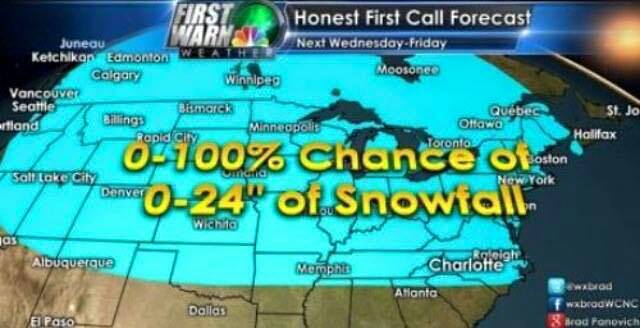
And the worst map of the year? Ryan Maue's continued efforts with the abominable rainbow colour schemes on his weather forecast maps.


He won the Gromit award for the worst map at the Mapping Together conference earlier in the year and I can't quibble. Worthy winner though there's also been some other humdinging cartofails such as...

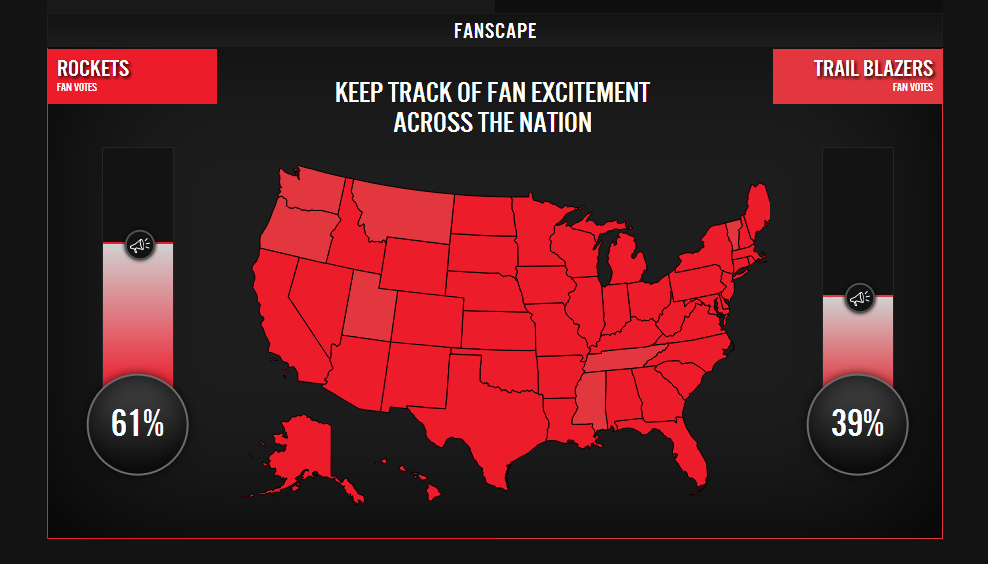
Embedded image permalink

Embedded image permalink


Embedded image permalink


And that's it for 2015. There's always a danger that between now and the end of December someone will publish something worthy of inclusion. Maybe. We'll see. Mappy Christmas.

Monday, 15 December 2014

Favourite maps from 2014

I'll get to my favourite maps from 2014 in a moment but first a few thoughts...

My impression of much of what we've seen in 2014 is that web mapping is maturing. Neo is not so neo any more. There are still plenty of ghastly mashups, nonsensical efforts and collections of '40 maps that will change your mind on something you never cared about anyway' but there's better quality too. While 2013 seemed to be the year when everyone was simply trying to out-score each other with different map styles, 2014 has seen less of that trend. Perhaps we're getting a little bored of the fact you can colour in your map a million different ways. Maybe we're moving a little away from the preoccupation with form (nice to look at) and beginning to see function reappear as a key reason for a map to be made.

The trend of mapping data from social media does, however, seem to be continuing unabated. Most commentators agree that Twitter data, for instance, is just plain dreadful with so much error, bias and uncertainty as to make it practically useless for teasing out meaningful trends. I've yet to see a well made map of Twitter data though technologically we're seeing some impressive data processing efforts to get the data on the map. It's a start but finding more nuanced ways of revealing something useful needs to be the next step.

Big data is still a buzzword but so often used inappropriately. As one of my colleagues said earlier in the year "if it fits on a portable drive it isn't big data so #$%* off". Maps are not exempt from the trend to simply map more and larger datasets and a key challenge is to re-think ways of representing millions of features on a map so as to make the map readable and to encode some message or meaning into the map. It's simply not good enough throwing a whole heap of data onto a map and expecting it to work, just because it's technically feasible to do so. Without cartography it's just a visual data dump even if you've coloured it in.

That brings me onto cartography in general. We're still seeing a marginalisation of cartography and cartographers by the avant-garde, the so-called new mapmakers. They seem, generally, to be more comfortable and less combative in the mapping space than a year or so ago (maturity again) but recognising so much of what has gone before still seems to elude many and they're still fond of reinvention. On the other hand, it's also true that cartographers still fail in reaching out and explaining their craft more widely. We are experts in our art and science and have a duty to share that with a society hungry for maps and mapping but I still see far too many who just sit back and watch from the sidelines. How many blogs do you see from real, proper cartographers? Why do we still hide good quality cartographic research in academic journals? This latter point may seem somewhat ironic given I just stepped down from editing one such journal but I've become increasingly uncomfortable with the journal as a sole means of disseminating research. If you've got something to say - say it to the people who need to know; and they're likely not the ones reading that academic journal. That said it's been pleasing to see some recent changes to how news-related blog sites report on cartographic work. There's less of the hysterical reporting of some latest greatest map (that likely isn't) and some good reporting of real cartographic work. Citylab have been doing this well recently.

2015 should see more development in the 3D space with improvements in the way in which data can be visualized more easily and responsively in web browsers. This being the case, it's incumbent on us to properly harness the potential of 3D and not simply use it for the sake of using it. In the same way that I've yet to see a real use for Torque animations (flashing lights showing where people tweet being the biggest culprit...stop press, actually this use showing Alcatraz escapee survival chances begins to use it meaningfully) it's also true that 3D is often used for no good reason. If data is truly temporal and has important characteristics that a temporal depiction can show then design to show that. If there is value in delivering the data to make some additional and purposeful use of the third-dimension then great - but there's more pitfalls to mapping both the temporal and third dimensions that need to be assessed to make the map work.

I'd also like 2015 to be a year in which cartography becomes just a little more recognised for its worth as a discipline and a profession. It seems we've been trying to get  everyone to think and work like cartographers for years but I'm not convinced this is the right approach. They're all busy trying to be professionals in their own areas. It also seems that for this to work, it would require a very rigid rules-based approach to allow people to follow to get to the end map (literally mapping by numbers). While many cartographic rules (I prefer to call them guidelines) exist to lead people down the right path, experimentation is playing a big part in modern cartography. It always has if truth be told. Some of this is in the academic space; some in the hacking space; but both modes of design and production are useful. Cartography is a profession and cartographic professionals are knowledgeable and practiced. They have a lot to offer. I firmly believe collaboration is key and I've long said that there's an important distinction between a professional and an amateur in any discipline or profession. I don't use the word amateur in a derogatory sense either - it's used to differentiate someone who is not formally trained, educated or practiced in a particular realm. We're all professionals at something and we're all amateurs at far more besides. Recognising that and collaborating with professionals from another area is likely to yield results that are greater than the sum of the parts. It might also save you time and frustration!

In a personal sense I made a frivolous map this year (the Proclaimers 500 miles nonsense) that got more hits to my blog (12,000) than virtually everything else I have ever done put together. It's possibly the worst piece of work I've ever done. It's not even a proper map. That's how frustrating and disappointing the internet can be.

So with that mini-review/rant out of the way, let me run through a few of my favourite maps from 2014. I was politely waiting for others to post their own lists but I got bored waiting so thought I'd rustle up my choices. They're an eclectic set but as I've spent the year writing a daily blog on the ICA Map Design Commission blog it's been a relatively easy process to narrow down my favourites this year.

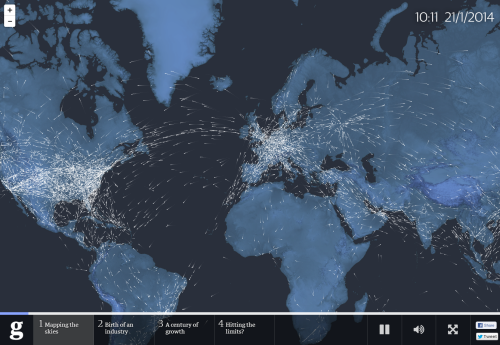
In Flight by Kiln (click image for web map)

http://www.theguardian.com/world/ng-interactive/2014/aviation-100-years

The idea of telling stories with maps is not new. The re-emergence of this genre through the medium of the web with the compilation of related multimedia to create a narrative has been a big story itself in 2014. This effort in The Guardian's web site remains one of the best framed I've seen. Simple idea. Good content. Not over-produced.

Barclays Cycle Hire by Ollie O'Brien

Ollie's been doing some great work with the London Bicycle hire data, particularly with some online mapping. I really like this static representation which BMJ used the map as their cover art to highlight a paper that explored the health benefits of the bikeshare scheme compared to other forms of transport. It's a simple flow map but simple often works very well and the saturated red of the routes is a clear metaphor for a blood capillary network and resonates well as cover art. Ollie even chose to exclude all other detail except for the iconic River Thames in the style of Beck's underground map.

Tokyo by Benjamin Sack


A black and white, printed map. There's still space in a list like this for a terrific perspective drawing of Tokyo that when viewed close-up shows incredible detail. No fancy web controls here...just beautiful cartography that builds off a fine legacy of illustrative bird's eye views.

Breathing City by Joey Cherdarchuk


A simple concept that does manage to use animation to good effect to show how New York City's population structure changes over a 24 hour period. There's a lot of data in here but it's represented with clarity and the animation brings to life the ebb and flow. the moving graph helps to contextualize the work.

One dot for every Starbucks by David Yanofsky


Mapping cities at the same scale is important to support the cognitive process of visual comparison. It's as simple as using the right projection...or using small multiples and mapping the same phenomena at the same scale. I like the way small multiples supports the process of visual comparison in this map. It helps that there are so many Starbucks outlets that the structure of each city is well defined.

NYC Taxis: A day in the life by Chris Whong (click image for web map)


http://nyctaxi.herokuapp.com/

A large dataset brought to life by focusing on a single entity at a time. This moving map takes you on a journey of a single New York City taxi cab. It shows a range of useful information including fares and a timeline. A lovely piece of work that works well, marries form and function and shows us what web mapping can be.

The United States: Her natural & industrial resources by Stephen Smith


Stephen based his modern version of the U.S. on a mid-century map of the United Kingdom. He did so with a keen eye and shows that modern maps don't have to constantly reinvent to be eye-catching and purposeful. He perfected a beautiful aesthetic and gave life to his data.

Skintland by The Economist


You can't beat a bit of satire in cartography and the shapes of maps gives artists a perfect canvas upon which to create something new and provocative. The Scottish vote for independence was too good an opportunity to miss and The Economist did a great job in creating this satirical map for their front cover.

The Milford Track by Roger Smith/Geographx


Pseudo-natural looking depiction supports this map's primary function for wayfinding. It's a map for walkers. The fact it's printed on rock (yes, rock!) makes it practically indestructable as well. The hill-shading and deep, rich colours gives this map a somewhat unique visual appeal but different is good in this case. Fine, detailed contour lines and expertly designed and positioned typographic elements makes it work well as well as looking great.

Canyonlands National Park by Tom Patterson


Tom Patterson's beautiful cartography once again shines in this exquisite depiction of the terrain morphology and colours of the landscape. Realistic rendering of the terrain captures not only the vertical component but also something of the horizontal structure and bedding to give an impression of rock texturing synonymous of historic, manually drawn relief and rock shading. There's a lot going on in the creation of this map but the devil is in the detail and it's the detail that makes this so easy on the eye.

London: The Information Capital by James Cheshire and Oliver Uberti


Not a map...but a book of maps. This really is a stunning collection of beautiful maps about all manner of different aspects of London and its populus. Each map has been carefully crafted to make the best use of the data and to speak to the theme of the map itself. Picking out one or two maps doesn't do it justice so here's a tip - go buy it. This is modern thematic cartography at its absolute best.

This is a top ten of sorts but honourable mentions to the following which on another day I might have easily put in this list:

Plan oblique relief Europe by Jonas Buddeberg, Bernhard Jenny & Johannes Liem
Space Station Earth by Eleanor Lutz
Columbia River watershed by Jake Coolidge
Lake Wakatipu by Simon Bardsley

All of these maps have got a fuller write-up on the ICA Map Design Commission blog this year. They contain large images and links where appropriate.

That's it for 2014, unless someone publishes something fantastic in the next 15 days. I'm also looking forward to everyone else's lists. They're bound to be different which is part of the subjective beauty of cartography. I'm also likely to have missed some.