Thursday, 9 January 2014

Old atlas, new projection

Charles O. Paullin and John K. Wright's Atlas of the Historical Geography of the United States, first published in 1932, is an award winning work of art. A magnificent historical atlas published ahead of its time and including innovative thematic representations. Each one of the nearly 700 maps makes it a truly fantastic cartographic work deserving of a new audience.

The Digital Scholarship lab of University of Richmond have gone to great lengths (and no doubt great expense) to bring this atlas into the 21st century by creating a digital version. It's described as an enhanced edition, a composite work of the combined efforts of students and staff with support from the Andrew W. Mellon Foundation. Please do go take a look because if you've never seen the original the new version opens it up to new eyes and a significantly wider audience. That's a huge positive.

The digital version effectively takes the scanned content from the atlas and places it atop a digital map so the atlas is reincarnated in an online form. Text panels are included, legends are thoughtfully added as insets on the page and there are some really sensible, intuitive and simple controls to help navigate the work, include textual context panes and provide interactivity.

In addition to general enhancements, there are three main improvements over the original that the new online edition claims in terms of functionality. Firstly, the maps are now clickable. Great! Now we can access the data to go with the maps and mine the information for specific places. This is one of the main benefits of any online map of course. Second, many of the maps in the original formed a series which were represented using side-by-side small(ish) multiples but now they are animated (effectively flicking between the overlayed small multiples). Again, web mapping supports animation very well and it's been used to good effect here. Rollovers are also used well, for instance to hover over the isochrones on the rates of travel maps and reveal location specific details. 

Third...the new edition contains "Georectified maps...warped so they can be placed consistently on top of a digital map".

<rubs eyes in disbelief> Come again?

While placing the maps into a consistent projection to support some of the other objectives (like animation) is cited as a reason for the georectification I'm completely bemused.

Paullin and Wright chose their projection perfectly. Albers is an equal area projection. It is absolutely the right choice to represent thematic information because it maintains area across the map meaning that no one part has its visual importance in our perception exaggerated.  This is crucial if we're to accurately compare the values on the thematic maps and not have those impressions modified by a projection before they even hit our eyes. Yet here, they've taken the original plates and manipulated them into Web Mercator. In so doing, not only have they changed the originals in terms of their dimensions, they've warped the message the maps communicate because they've distorted area. The unnecessarily curved text is really just an inconvenience of the process...there are bigger implications though it does show clearly the impact of changing projections on a map. Northern latitudes suffer most from the warping so they now appear larger in relation to southern latitudes.

Take the following as comparison. There is more yellow on the georectified top map than the original shown beneath. Your first impression is slightly different depending on which map you look at. The way your brain assimilates the image is based entirely on the area that each colour fills. This impact is subtle on some maps, profound on others.


And what of the impact on those nice round proportional symbols?


Not round any more so our ability to assess relative size is impeded.

At least you can toggle between the georectified maps and the original plates but here's my very simple beef with this work...why not use an Albers digital basemap? Why go to all that effort of making the old maps fit a completely inappropriate projection when the original authors had already chosen the right projection? Why let the tail of the default web map projection dictate the needs of the new digital version? There was nothing about the digital version that demanded Web Mercator. Just reconfigure your map app to use Albers and you not only save a considerable amount of work processing all those maps to nicely fit Web Mercator, you actually preserve the use of the correct projection.

What a shame...a terrific project with so many good elements but one utterly incomprehensible cartographic howler. They're not the first to fall into this trap though. Plenty of other large, highly lauded projects have also taken the Web Mercator route rather than tackle the issue of projections properly.

Tuesday, 7 January 2014

Cartolove

Via my geopal Ed Parsons I read an article in today's New York Times entitled 'A makeover for maps'. It's effectively an interview with Eric Rodenback of Stamen Design that frames an argument for how he is trying to rethink how data is presented...graphs, maps, animation etc. Time was when we called a graph a graph, a map a map and the art and science of making them... cartography. Not any more.

Ed pointed out that, unsurprisingly, the term 'cartography' is not mentioned once in the article (though it subsequently is in the many comments). This isn't the first time we've seen this apparent glossing over of 'cartography' and I've mentioned this issue before in a previous blog.. Is this a problem? Do maps need a makeover? Does everything new have to be described as 'rethinking' as if in some way that elevates it to some new, more profound level of importance for which we should be eternally grateful for the insight?

Maps have changed. The people making them have also...and so have the tools of production. Data is now seen as different (but possibly it's just because there's so much more of it and it's more complex to sift it into something meaningful). All of the components of cartographic practice have evolved immensely. Consumption has also changed. We demand immediacy in our information so waiting for weeks to publish a map or to see a map is no longer acceptable to most. It has to be done rapidly and with maximum visual impact to resonate and satiate the appetite of our fleeting interest. So we end up with people creating new 'visualizations'...and there we have another term to throw into the mix to avoid using the term 'cartography'.

Cartography undoubtedly has an image problem otherwise there wouldn't be so many people re-thinking it. It has for years been seen as old-skool, stuffy, populated as a disipline with people who yearn for the long lost age of the scribing tool. Even the modern ones are seen as archaic if they dare to suggest their tool of choice is Adobe Illustrator...heck, even GIS is now considered as 'paleo' if that's how you make your maps. But as much as some of this is true, people 'new' to making maps are also fundamentally responsible for perpetuating the myth that what they are doing is something new. They don't want to be seen as belonging to something that pre-existed because that dilutes their relevance. They want to be modern, clean and avant-garde...just like the 'visualizations' they create. They claim there is a gulf between what went before and what they are doing and it demarcates something fresh and different. It suits them to be different because different is good and it sets them apart as new and important players in the landscape. They need to be seen to be doing something 'new' to fulfill that destiny.

Bullshit.

I challenge you to look at any modern map or data visualization or whatever you want to call it and not be able to see clear lineage to cartographic theory or practice.  The challenge of how to present data meaningfully has been what cartography has been concerned with for centuries. The number of times I see something that purports to be a 'new way of seeing this or that' when I can probably pick out an example from 5, 10, 20, 50 years ago is becoming laughable. There is prior art for most of what we see today. Just because some people are unwilling to acknowledge it or aren't aware of it doesn't mean it never happened. Yes, people are experimenting and pushing boundaries. Yes, they are doing exciting things in the cartographic space. This has always been the case in any generation of cartographic evolution. Occasionally some seriously great work emerges to add to the canon that is truly a progression of note...but by and large I can see the use of Bertin's visual variables, cognitive theory or a particular projection, or the development of some experimental time-space animations from 15 years ago or a range of almost all other cartographic stuff.  Computing and technology are making it easier to implement. Graphics engines are making it possible to do things that are more polished, faster and more visually arresting...but the lineage is still there. It's cartography by whatever other name you want to call it....except most call it anything but cartography.

Making maps is now considered part of what designers do...but also what data scientists, journalists and artists also do. The pool of map-makers has expanded and people are now finding out about cartography in their own ways but if the output is a map-like object you are doing cartography to some extent even if you hate to think of it that way. You might do it well, you might do it poorly (depending who you show your work to), you might do it having read up on a technique or you might have stumbled across a way of representing stuff that makes sense to you and which you never knew had been done before. Whatever the process, you're doing some cartography. Cartography, though, is probably the last term you would use to describe your work.  It continues to have an image problem. It's just not a sexy term and old stuff doesn't sell well unless you invent a new way of selling it.

Digging a little deeper, most cartographers would probably concur that a lot of what they see isn't very 'cartographic' because use of that label implies a professional touch...a professional cartographer's touch. That doesn't necessarily make the work amateurish. Far from it...but that view does tend to support the philosophy that there is cartography...and then there is the new way. That distinction is crucial because it feeds the divide. Cartographers have a skill set learnt and practiced. It's their professional area of expertise yet as a discrete profession it's been on the slide for years. Unfortunately, when the rest of the world decided to get busy mapping, cartography was still slumbering and failed to pick up the pace. It got overtaken so the high ground of modern map-making is no longer ruled by people from that profession. Consequently their voice is diminished and their ability to influence is weakened. That's not to say others cannot become proficient or, indeed, far better at making maps. Many great maps are made by non-cartographers. But as long as that distinction of 'us and them' and the notion of what skill-sets new and old map-makers can bring to the table remains, the divide will grow...the term cartography will become even less attractive and it will slowly die. More people will seek their advice on making maps from designers, coders, data scientists and anyone else who has stumbled across cartography...rather than getting a cartographer involved. That would be sad to see because so much of what is being re-thought already exists. You've just got to talk to the right people, read the right books/blogs and engage with the past as a way of informing your desire to shape (not reinvent) the future.

Cartography is a great term and it's entirely appropriate for most of what we see today. Rather than being seen as elitist or defining a small group of like-minded old-skoolers its use should be expanded to encompass modern thinking and practice. As the President of ICA, Georg Gartner, said at the International Cartographic Conference in 2013 "It's OK to be a cartographer". Well yes, it is...but only if you want to be frowned at, ignored, derided  and so on...until some of the newer crowd get over their hang ups about the term and accept what they are doing is not profoundly new (as in not a new paradigm) but is, in fact, simply a development of what went before supported by changes in technology. It also requires those with a longer cartographic history to get with it...change has happened and fast but you might need to modify your view of what you do to be seen as relevant until people come round to using the term cartography in a positive way again. This is more profound than just semantics. This is about us potentially consigning a great term to history simply because different tribal tendencies have seen it fade out of fashion. We need to encourage some carto love (as another of my geo pals Gary Gale said) and once again see cartography as something more than just worthy...it needs to become fashionable once again. It needs a good re-branding job. Then we genuinely can begin to think of a new golden age of cartography.

Tuesday, 31 December 2013

Worst map of 2013

Update: since I wrote this blog the author of the map concerned got in touch with some vitriol and a lack of humour citing some copyright nonsense, unprofessionalism and such like. He had a less than enthusiastic take on my writing on what remains the worst map of 2013. I guess the truth hurt and he failed to see the tongue-in-cheek approach I took to this. Despite the fact I know I am well within my rights to use the image under the principle of 'fair use' the author was being somewhat difficult. So the image is removed...but you can click on it to go to his tweets directly (wear shades). He tweets this bilge daily. yes, it is bilge. He might not like my humorous take on his efforts but make a map that bad and it deserves to be completely slated in unflattering terms.

My friend and colleague Craig Williams posted this gem on Twitter and it immediately registered as possibly the worst map I have seen in a long while...and for that alone it's gone straight in as my worst map of the year (by someone other than me). So bad, it's not even in a top ten - it's in a list of one.


Colours...holy mother of all that is decent...this is out of bounds, off the hook, shut the door and throw away the key awful. Not content with a simple rainbow effort this crowbars two of the worst colour ramps I have ever seen together in one discontinuous continuous blur. A symposium of technicolour psychedelic vomit across the map. Zero or -100? -20 or 125? You tell me. Land or water? Again, tricky.

Good job they added temperature annotation all over the map so you don't need to worry about the colour...at least it would be if you could make them out. Quite a bit of overlapping annotation and black lines overprinted make that task a little tricky.  You'd like to think labels means land and no labels mean water but no...some (not all) water has labels to.

Somewhere in there is a coastline but with State boundaries also on board that bisect the Great Lakes it makes uncovering that a little cumbersome. And look at those beautiful offshore temperatures...what accuracy...what precision...each colour and one degree of temperature change gets its own contour interval. 

And zero...that's the huge cliff drop in colour across the map. How many 'white-ish' zones does the ramp go through? Well there's one at about -45, another at 0...one more at 30. Ugh! 

At least it has a title...erm, well...it has a collection of codes and characters across the top, some of which make some sense.

It squeaked in at the end of the year but it's singularly the most worthy effort of the crown of cartographic failure of the year for this cartonerd at least. The very reason that cartography exists is to prevent this sort of crap. Please people...let's try a little harder and not insist on using every single crayola.

I'm quite sure weather modellers would say they understand this nonsense perfectly well (or maybe it explains why weather forecasting is as much miss as it is hit?) but modelling the map on some Grateful Dead album cover from the 1970s is taking things too far. Actually...no it isn't...


Happy Mappy New Year to you all (except for the author of this map who has no sense of humour)


Saturday, 21 December 2013

Favourite maps from 2013

Everyone and their dog tends to publish their own 'best maps of...'. Given I spend most of my time on this blog haranguing bad maps during the year I thought I might try it myself this year so here goes, in no particular order...my favourite 10 maps of 2013. For those that are counting, there's 11 but here goes...

NYCHenge by Andrew Hill

The Manhattan Solstice occurs twice a year when the setting sun aligns perfectly with the east-west street grid in New York City. This map could not be any simpler but it captures the phenomena perfectly. Intuitive, interactive controls and a great use of colour allow viewers to explore the way in which the sun splashes across the city throughout the year. Temporal data, perfectly represented with expert use of colour and contrast.


http://nychenge.com/


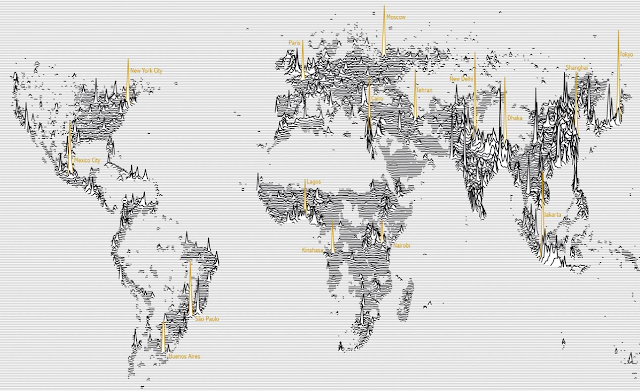
Population Lines by James Cheshire

Global population density drawn as horizontal lines...almost like a cardiograph of the pulse of the world's populus. Not the first map of population that's ever been made but a compelling, alternative and fresh approach. A map that is also a piece of art and the beauty of it's design lies in its simplicity with colour used sparingly and for emphasis. There's an attention to detail that most will overlook that makes this so pleasing to view. Design is implicit.


http://spatial.ly/2013/09/population-lines/


Tornado Days by Brenden Heberton

2013 saw any number of maps made using NOAA's historical tornado data but this example did a fantastic job of going beyond the map by combining a wide range of multimedia in an innovative way.  The reader scrolls down to reveal new facts, new maps and a new layout. This heightens the interest and keeps people immersed in the rich story being told. Maps as a component of a story...expertly collated and combined with related material.


http://benheb.github.io/tornado-days/


PLUTO is Free! by Andrew Hill

A selection of maps that celebrate the release of New York City's PLUTO dataset. As you cycle through, the range of maps is well matched to each dataset and illustrated with simple, effective and eye-catching approaches. The maps were initially prepared to provide images for projection at a party but as a linear gallery, they work here to highlight not only the data but high quality cartography, professionally applied in a clean UI.


http://andrewxhill.com/cartodb-examples/scroll-story/pluto/#1


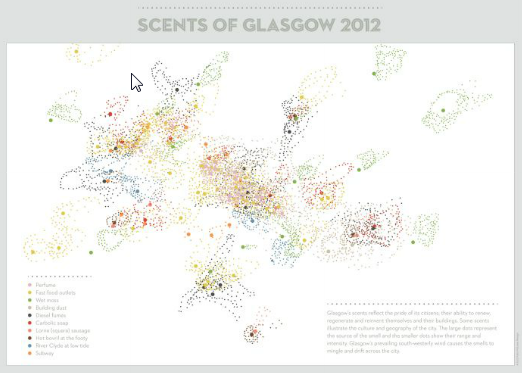
Scents of Glasgow by Kate McLean

Putting the art in Cartography; a visual art installation that combines a map of perceived smells from Glasgow during the winter of 2012 with bottled scents. The idea is to use the map, combined with 9 bottled scents to inform the culture, history, planning and climate of the city. Soap, Bovril, damp moss, sausage all represent synonymous places. The map shows the centre of the smell and how it dissipates using proportional symbols. It's art. It's c'art. It's done beautifully.

http://www.sensorymaps.com/maps_cities/glasgow_smell.html


Cloudless Atlas by Mapbox

A fresh approach to making a mosaic of NASA's LANCE-MODIS data. Rather than taking the best image of a particular place and then quilting them together, Mapbox stacked images and processed them, pixel by pixel to get the average of the least cloudy pixel before stitching it all back together to create a seamless cloud-free atlas. Completely synthetic but a great example of using generalisation techniques to create a product that is greater than the sum of its parts (literally). Beautiful imagery.


https://www.mapbox.com/blog/cloudless-atlas-with-landsat/


Global Wind Map by Cameron Beccario

Fernanda ViƩgas and Martin Wattenberg's Wind Map of the USA was one of the best maps of 2012. Here, a similar approach is applied globally for near real-time data. A mesmerizing, beautiful depiction of global weather patterns though the serene nature of the map belies the potential power and savagery of the mapped theme. Intuitive UI and some simple and useful ways to modify the view. Neat.


http://earth.nullschool.net/


Collins Crossworld Puzzle by Kenneth Gibson and Kathryn Kelly (Collins Bartholomew)

The world map...as a crossword. That makes it a crossworld. Geddit? Such a simple idea and a well crafted design with clues that broadly fit the locations of their position on the map. Sometimes the simplest of ideas can turn into the most effective of maps. Interaction is implicit. The classic black and white print crossword depiction is favoured and thankfully the temptation to colour continents was ignored. Great work.


http://www.collinsbartholomew.com/PDF/Collins%20Crossword%20Puzzle%20With%20Answers.pdf


The Next Big Spill by Lauri Vanhala

Beautiful production on this video of marine traffic in The Baltic Sea gives the map a cinematic quality. The map is the main actor but the supporting cast of captions makes it easy to understand. The map provokes a questioning approach to what you're seeing. The zooming, panning and soft-focus gives the map a strong aesthetic and the use of a sensible soundscape adds to the atmospheric approach.


http://www.youtube.com/watch?v=X9UtUzHDn4c


Restless America by Chris Walker

Proving that a map doesn't need to take a conventional form, here a chord chart shows the inter-state migration of people in the US in 2012. Good use of size to conotate magnitude and colour to enable differentiation between the States. Simple mouseover interaction means viewers don't get RSI through having to click everywhere. Trying to put this information onto a map wouldn't work as it'd be too overcrowded. This woks. Simply.


http://vizynary.com/2013/11/18/restless-america-state-to-state-migration-in-2012/


Khumbu Himal by Institute of Cartography at TU Dresden

Classic mountain cartography gets a refresh. There's a new colour scheme to go alongside the additional topographic detail derived from new surveys and satellite imagery. The lineage of classic Imhof-inspired depiction of mountain terrain is evident but the colours have been tweaked to give even clearer lines. The detail is breathtaking and although the map is abstract (the earth doesn't actually look like that of course), the colours and symbology give you an unparalleled sense of place.


http://icaci.org/map-of-the-month-122013/


I've probably missed a few but these are the ones I remember so on that basis alone they obviously registered somewhere in my mapping subconscious. Agree? Disagree?

What can we expect from 2014? World Cup Maps....probably as cartograms.